Programs (EN)


Programs
From age 0 to 15,
designed as one continuous course of inquiry
Preschool to middle school / Inquiry-based bilingual education
Preschool, elementary, middle school. Learning at ISN is built on the framework of the IB (International Baccalaureate) and on our own programme, developed since 2012.
Program Map
From play to inquiry, and on to co-creation
The educational thinking stays the same; only the shape of the learning changes with each stage. Whatever the stage, the core stays the same: ask your own question and find out for yourself.
Preschool
Age 2 to school entry (from 7 months at Saku Kirihara)
English is the language of the day, from arrival to home time. In the daily “IB Time” (inquiry time), children think, ask, try, reflect and then tell others in their own words — a cycle repeated every day. Japanese sessions are built in so both languages grow.
Elementary school
G1–G6
Inquiry sits at the centre of the timetable, and project-based learning runs in English throughout. Japanese and mathematics are also taught in Japanese all year, following the national curriculum. Assessment uses a range of methods: conventional tests make up only a very small part of it, and learning is read from the inquiry process and from creative presentations.
Middle school
G7–G9
PIC: Project, Inquiry, Concept based Program. Three years of inquiry connecting with local businesses, with nature and with the world. Eight projects with companies from different industries, each running for six months. Japanese and mathematics are also taught in Japanese.
Foundations
Four foundations common to every stage
These four do not change, whichever campus or year group you are in.
Inquiry
Inquiry, as a daily habit
“IB Time” every day in preschool; “Inquiry” fixed in the timetable in elementary. Asking a question, looking into it, trying it out, pulling it together and telling someone — repeated as a daily habit, not as an occasional event. It is the IB way of inquiring into a theme, brought down into the rhythm of ordinary days.
Bilingual
Think in English, deepen in Japanese
In preschool, English is the language of the day from arrival to home time. In elementary and middle school much of the teaching is in English, while Japanese and mathematics are learned in Japanese. English is not memorized as a subject; it is used, continuously, as a tool for thinking.
Assessment
Assessment through presentation and dialogue
Rather than ranking by score, we look at learning from many sides, including attitude and method. Results are shown as creative presentations, and the next goal is decided in dialogue between teacher and student, and among students. Setting your own goals, reflecting and assessing yourself are built into the learning.
Place-based
Shinshu’s nature and community, as an extension of the classroom
Activities using the resources of the town — parks, the pool, the gym — are built into every week, and hiking, farming and skiing run through the seasons in the curriculum. Nakano Campus is an environmental education provider for the Shiga Highlands UNESCO Eco Park, and for middle school, working with local businesses is at the heart of the learning.
Learning Facilitator
Educators who grow a child’s ability to learn
01
What Does a Learning Facilitator Do?
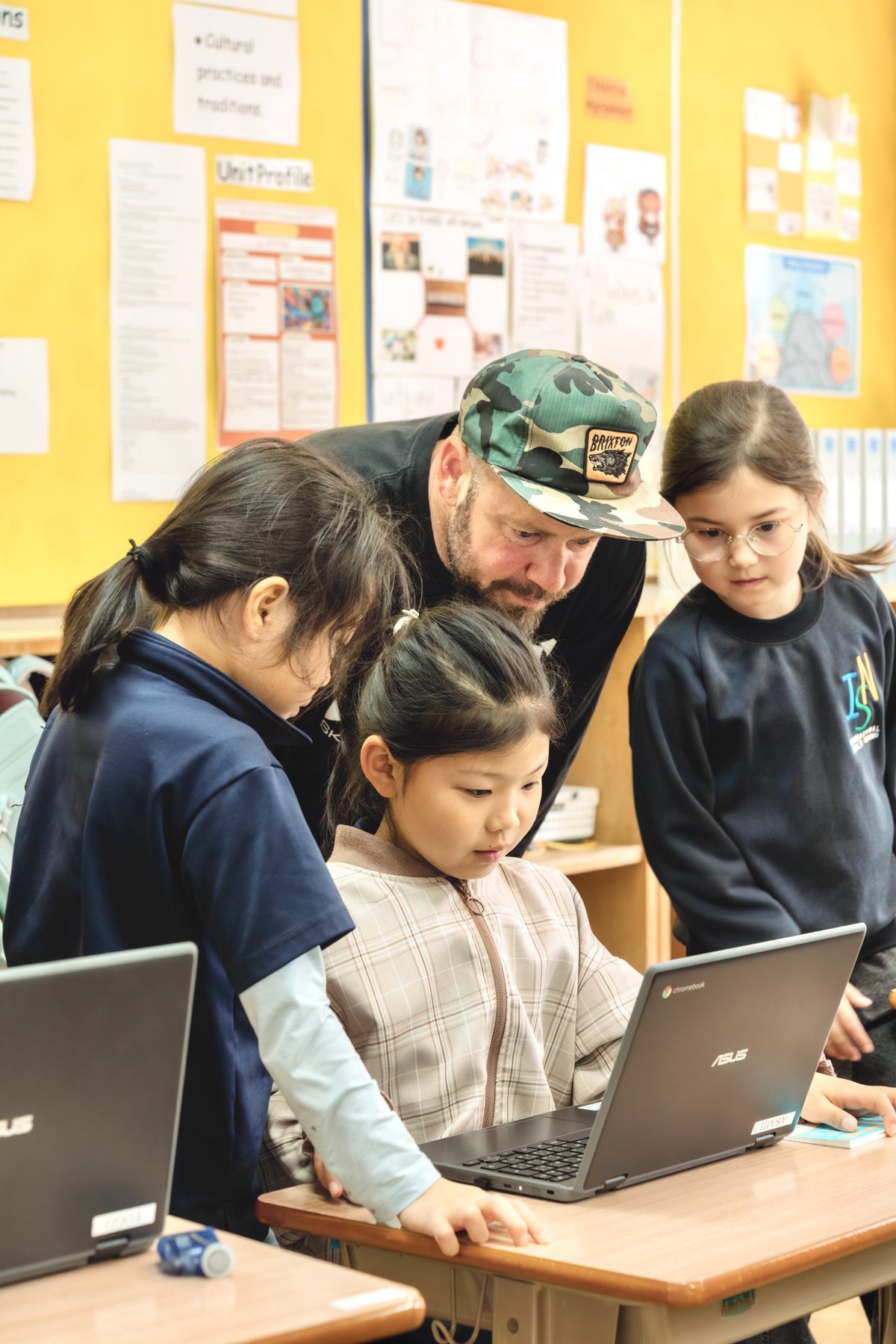
A Learning Facilitator continues to introduce essential knowledge and skills while empowering students to become active participants in their own learning.
A Learning Facilitator:
- explicitly introduce new concepts and skills;
- asks questions that promote thinking and inquiry;
- provides guidance, feedback, and appropriate scaffolding;
- encourages student agency and independence;
- supports students in reflecting on their learning;
- creates a psychologically safe environment where mistakes become opportunities for growth;
- designs meaningful learning experiences that develop both knowledge and character.
In simple terms,
A Learning Facilitator is a teacher who not only teaches content but also empowers students to become confident, independent, and lifelong learners.
02
Why Are We Making This Change?
Introducing the title Learning Facilitator is more than a change in terminology, it is a reflection of ISN’s educational philosophy and our commitment to empowering every learner.
The title recognizes that while excellent teaching remains at the heart of education, our role also includes coaching, guiding inquiry, nurturing independence, fostering meaningful relationships, and creating learning environments where every child can thrive.
The title reflects not only what we do, but who we are as educators at ISN.
03
Consistency Across ISN
The ISN Program Guide defines how we support learning through coaching, collaboration, inquiry, learner agency, psychological safety, and continuous growth.
The title Learning Facilitator defines who we are.
Together, they establish a consistent professional identity that aligns ISN’s vision, educational philosophy, and everyday practice across all campuses.
By aligning our professional identity with our vision, the IB philosophy, and the ISN Program Guide, ISN takes another step toward becoming an even more coherent, future-focused learning community.
A Day at ISN
The shape of a day
How the time is used changes with the stage, but inquiry sits at the centre of the day in every one.
An example from the age-5 class at Minami-Matsumoto. Timetables vary by campus, class and age.
How the time is used across the Gojo and Nakano elementary schools. It varies by year group and term. Club activities run after school.
What is the IB
The IB as a framework
What underpins learning at ISN is a programme shared around the world.
The IB is an international education programme provided by the International Baccalaureate Organization (headquartered in Geneva). It was established in 1968 to raise students who can understand and engage with the complexity of the world, to give them the attitudes and skills to act responsibly towards the future, and to provide an internationally recognised university entrance qualification. Today the organization develops a shared curriculum for authorised schools, runs the worldwide IB examinations and awards the IB Diploma.
Students are encouraged to learn on their own initiative through exploration, experiment and discovery, with an emphasis on widening their interests both inside and outside lessons. As of January 2022, 7,500 programmes were offered at 5,400 schools in 159 countries. Four programmes are provided, according to the age of the student, and the one offered at ISN is the PYP, for ages 3 to 12.
PYP
Primary Years Programme
Ages 3–12 / established 1997
The primary years. It values the development of both mind and body, and builds a wide range of social and learning skills. The focus is on connecting what interests a child with growing as a person.
The other three programmes — the MYP, the DP and the CP — are for ages 11 to 19 and are not offered at ISN.
Listing on the IB Consortium Website
International School of Nagano (ISN) currently has three campuses—Shimauchi Campus, Minami-Matsumoto Campus, and Nagano Campus—that are authorized as IB (International Baccalaureate) World Schools.
International School of Nagano Elementary School, an officially accredited school under Article 1 of the School Education Act and located in Gojo, Matsumoto City, Nagano Prefecture, is currently an IB PYP candidate school, pursuing authorization separately from the IB-authorized campuses listed above.
The IB Consortium website generally lists only schools that have received IB authorization; candidate schools are not included in its listings.
For this reason, International School of Nagano Elementary School, which is currently a PYP candidate school, does not appear in the Article 1 School section of the IB Consortium website.
Please note that its absence from the IB Consortium website does not indicate that the school is not an Article 1 School. Rather, it reflects the Consortium's listing criteria based on a school's current IB authorization status.
View the MEXT IB Education Promotion Consortium list of IB World SchoolsThe list is published in Japanese; look for “International School of Nagano”.
ISN & the IB
A history of the IB at ISN
PYP candidate school
PYP candidate school
Accreditation
Accreditation by campus
All campuses are run on the same educational thinking, but the type of accreditation differs from one to another.
| Campus | Division | Accreditation and provision |
|---|---|---|
| Minami-Matsumoto | Preschool | IB World School (PYP)Accredited nursery school |
| Shimauchi | Preschool | IB World School (PYP)Accredited nursery school |
| Nagano | Preschool | IB World School (PYP)Unlicensed childcare facility (eligible for free early education) |
| Saku Kirihara | Preschool | Accredited nursery schoolOpened 2026 |
| Gojo | Elementary | Article 1 schoolIB PYP candidate school |
| Nakano | Elementary | IB PYP candidate schoolShiga Highlands UNESCO Eco Park environmental education provider |
| Gojo | Middle school | Free school (PIC Program, operated by WIP LLC) |
| Nakano | Middle school | Opening in 2028 |
Our history and corporate information are on the About us page.
PIC Program
The final stage: real problems, with local businesses
The middle school curriculum, the PIC Program, is built on four pillars.
Projects with companies
Eight projects with companies from different industries, each running for six months. Students look at the industry’s challenges themselves, form their own questions, and present their own ideas.
Teaching in English and
National Geographic LIFT
A curriculum that carries forward the philosophy of the National Geographic Society. Through English and other subjects, students discover their connection to the world and grow the capacity to empathise.
The MEXT curriculum
The core elements of the Japanese middle school curriculum, essential for going on to high school, are taken up as the guide for building the PIC curriculum. Japanese and mathematics are also taught in Japanese.
Activities in the nature of Shinshu
Fridays are given to activities out in nature. Mornings are Monthly Concept Learning in English; afternoons are Japanese and mathematics in Japanese, plus individual study.
Partnership
Parents, too, as fellow learners
With inquiry-based learning, how families engage at home changes how children grow. ISN creates opportunities for parents to engage with the substance of their children’s learning.
IB workshops for parents
Held once or twice a year at most campuses. Time to look, together with teachers, at how the IB thinks and at what is happening for a child inside the cycle of inquiry. The aim is not to show what happens at school, but to be able to talk about it within the same framework.
Seeing the presentations for yourself
Open lessons, the science fair, the speech contest, the music concert, the sports festival. The results of inquiry are presented in the course of ordinary days, and parents are there for it. Better than any brochure is a child explaining it in their own words.
FAQ
Frequently asked questions
Is it okay if my child only speaks Japanese?
Yes, absolutely. For preschool and elementary grades 1–2, we accept students with no English requirement. For transfers from grade 3 onward, we conduct interviews with the child and parents, and if needed, a brief assessment, to ensure a smooth transition.
What does ‘Article 1 accreditation’ mean?
It refers to being an officially recognized school under Article 1 of Japan’s School Education Act. At ISN, Gojo Campus Elementary holds this Article 1 accreditation. Meanwhile, Nagano-Nakano Campus Elementary and Junior High are not Article 1 schools, but maintain close coordination with students’ registered public schools to ensure proper learning environments and guaranteed graduation credentials.
What are the costs?
Costs vary by program and campus. Details are provided upon requesting information or during a campus visit. As an Article 1 school, tuition support programs may apply.
Can students from outside Nagano Prefecture enroll?
Absolutely. Currently, about 20–30% of our students are families who relocated from outside Nagano Prefecture, bringing diverse backgrounds from across Japan. We also provide relocation support information — please don’t hesitate to ask.
The programme is easier to see than to describe
Come while the children are in the middle of their inquiry.